
Portillo’s History & Story: From Trailer to Titan
From a humble hot dog stand to a fast-casual powerhouse, Portillo’s story is pure American hustle. This deep dive unpacks how smart menu engineering, regional identity, and obsessive quality control turned a small Chicago concept into a multi-state brand.
What is Portillo’s?
Portillo’s is a Chicago-born fast-casual restaurant chain founded in 1963 by Dick Portillo. Known for Chicago-style hot dogs, Italian beef sandwiches, and indulgent desserts, it has grown into a multi-state brand recognized for consistency, nostalgia-driven branding, and high-volume operations.
The Origin Story: A $1,100 Gamble That Paid Off
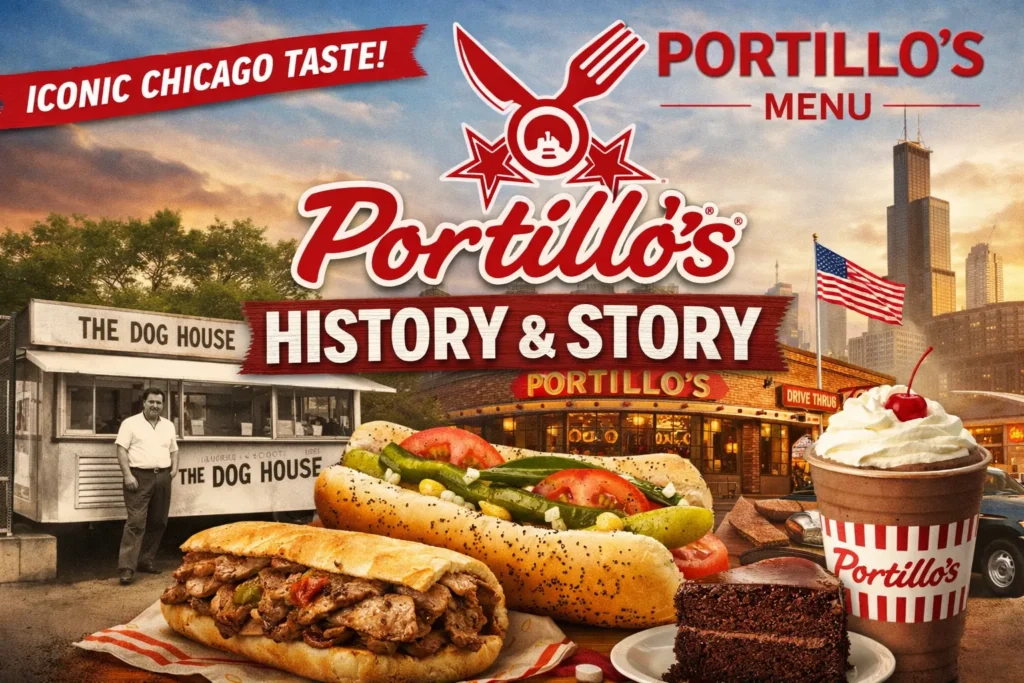
In 1963, Dick Portillo opened a small trailer called “The Dog House” in Villa Park, Illinois. The investment? About $1,100. No investors. No corporate backing. Just a sharp instinct for what people actually wanted to eat.
What made it work early:
This wasn’t luck. It was disciplined execution.
The Chicago Identity Advantage
PPortillo’s didn’t try to chase trends or dilute its menu to please everyone. It locked into Chicago’s food DNA and executed it with near-obsessive consistency. That decision turned a local menu into a cultural signature.
Core Menu Focus
These aren’t random items. They’re Chicago institutions. Portillo’s didn’t invent them, it standardized and scaled them without losing authenticity.
Why This Strategy Works
1. Cultural Positioning > Generic Fast Food
Most fast-food brands compete on price or speed. Portillo’s competes on identity.
It’s a regional experience packaged for mass consumption
👉 That’s a completely different game.
2. Menu Discipline Creates Brand Power
Instead of bloating the menu:
This creates:
According to insights from Datassential, focused menus outperform large menus in repeat customer retention.
3. Emotional Connection = Higher Lifetime Value
Customers don’t just eat Portillo’s, they identify with it.
This taps directly into a behavioral driver highlighted by Mintel:
👉 Consumers prefer familiar indulgence over experimental dining in fast-casual settings.
The “Regional Moat” Effect
Portillo’s built what most restaurants fail to achieve:
A moat based on identity, not price
| Weak Brands | Portillo’s |
|---|---|
| Compete on discounts | Competes on culture |
| Generic menu | Region-specific menu |
| Easily replaceable | Emotionally sticky |
| Trend-dependent | Tradition-driven |
Real-World Insight
If you’re building a food brand, here’s the uncomfortable truth:
👉 Trying to appeal to everyone kills memorability
Portillo’s proves:
Bottom Line
This tight Chicago identity created a defensible market position. Customers weren’t just buying food, they were buying a piece of Chicago, served hot, fast, and exactly the same every single time.
Key Growth Drivers
Why did Portillo’s grow so fast?
Scaling Without Losing Soul
Unlike many chains that dilute quality during expansion, Portillo’s took a slower, controlled route.
Growth strategy:
This aligns with findings from Datassential, which highlight that menu consistency is a top driver of repeat visits in fast casual dining.
Menu Engineering: The Real Secret Weapon
Portillo’s menu is not random. It’s engineered.
Why it works:
According to Mintel, U.S. consumers increasingly favor “familiar indulgence” exactly what Portillo’s delivers.
U.S. vs Canada: Expansion Reality
Portillo’s is still primarily U.S.-focused, but its model fits Canadian markets.
| Factor | United States | Canada |
|---|---|---|
| Food culture | Regional specialties thrive | Diverse, multicultural demand |
| Regulations | USDA standards | Health Canada compliance |
| Expansion challenge | Competition saturation | Market entry barriers |
| Opportunity | Brand nostalgia | Premium fast-casual gap |
Insight:
Canada offers growth potential, but adaptation (portion sizes, sourcing, pricing) would be required.
Real-World Use Case: Why Restaurants Study Portillo’s
Portillo’s is practically a case study for:
Key takeaway:
If your kitchen can’t handle volume without breaking quality, you don’t scale. Period.
Operational Excellence: Built for Speed
Portillo’s kitchens are designed like assembly lines.
Key systems:
- Pre-prepped ingredients
- Station-based workflow
- High-speed order fulfillment
This mirrors USDA-recommended food safety and efficiency practices from USDA guidelines for high-volume food service.
Branding: Nostalgia as a Growth Engine
Walk into a Portillo’s and it feels like stepping into a time capsule.
Branding elements:
- Vintage Americana decor
- Loud, energetic atmosphere
- Humor-driven messaging
This taps into a powerful consumer behavior trend: comfort-driven dining, especially post-pandemic.
Frequently Asked Question
Summary
Portillo’s success is not accidental. It is built on disciplined menu focus, operational efficiency, and deep-rooted regional identity. By sticking to Chicago-style classics, the brand created a strong emotional and culinary connection with customers. Its growth strategy prioritized consistency over speed, which paid off long term. Research from Mintel and Datassential confirms that familiarity and reliability drive repeat dining, both of which Portillo’s delivers. While expansion into Canada presents challenges, the opportunity remains strong with the right localization. Ultimately, Portillo’s proves that doing a few things exceptionally well beats doing everything poorly.